
According to preliminary calculations, China’s annual gross domestic product (GDP) reached 14,018.79 billion yuan, representing an increase of 5.0 percent over the previous year. Within this total, the value added of the primary sector was 933.47 billion yuan, up by 3.9 percent; the secondary sector contributed 4,996.53 billion yuan, an increase of 4.5 percent; and the tertiary sector added 8,088.79 billion yuan, rising by 5.4 percent. Consequently, the primary sector accounted for 6.7 percent of GDP, the secondary sector for 35.6 percent, and the tertiary sector for 57.7 percent. In terms of demand components, final consumption expenditure contributed 2.6 percentage points to GDP growth, gross capital formation contributed 0.8 percentage points, and the net exports of goods and services contributed 1.6 percentage points. Looking at quarterly performance, GDP grew by 5.4 percent year‑on‑year in the first quarter, 5.2 percent in the second quarter, 4.8 percent in the third quarter, and 4.5 percent in the fourth quarter. Per capita GDP for the year was 99,665 yuan, an increase of 5.1 percent over the previous year. Gross national income stood at 139.37 trillion yuan, up by 5.1 percent, while labor productivity reached 184,413 yuan per person, an increase of 6.1 percent.
At the end of the year, the national population was 1,404.89 million, a decrease of 3.39 million from the end of the previous year. Among this total, the urban resident population numbered 953.80 million. There were 7.92 million births during the year, corresponding to a birth rate of 5.63 per thousand, and 11.31 million deaths, giving a death rate of 8.04 per thousand, so the natural growth rate was negative 2.41 per thousand.
The national workforce totaled 725.04 million people, of whom 475.35 million were employed in urban areas, accounting for 65.6 percent of the total workforce. New urban employment for the year reached 12.67 million people, an increase of 110,000 compared with the previous year. The average national urban surveyed unemployment rate for the year was 5.2 percent, and at the end of the year it stood at 5.1 percent. The total number of migrant workers nationwide was 301.15 million, an increase of 0.5 percent over the previous year. Of these, 180.06 million were migrant workers working outside their home regions, an increase of 0.8 percent, while 121.09 million were local migrant workers, an increase of 0.1 percent.
The consumer price index remained unchanged from the previous year. By contrast, the producer price index for industrial products fell by 2.6 percent, the purchase price index for industrial producers fell by 3.0 percent, and the producer price index for agricultural products fell by 3.7 percent. Focusing on the housing market in December, among 70 major and medium‑sized cities, the number of cities where sales prices of new commercial housing rose month‑on‑month was six, remained unchanged in six, and fell in 58; meanwhile, sales prices of second‑hand housing fell month‑on‑month in all 70 cities. Year‑on‑year, new commercial housing prices rose in five cities and fell in 65, while second‑hand housing prices fell in all 70 cities.
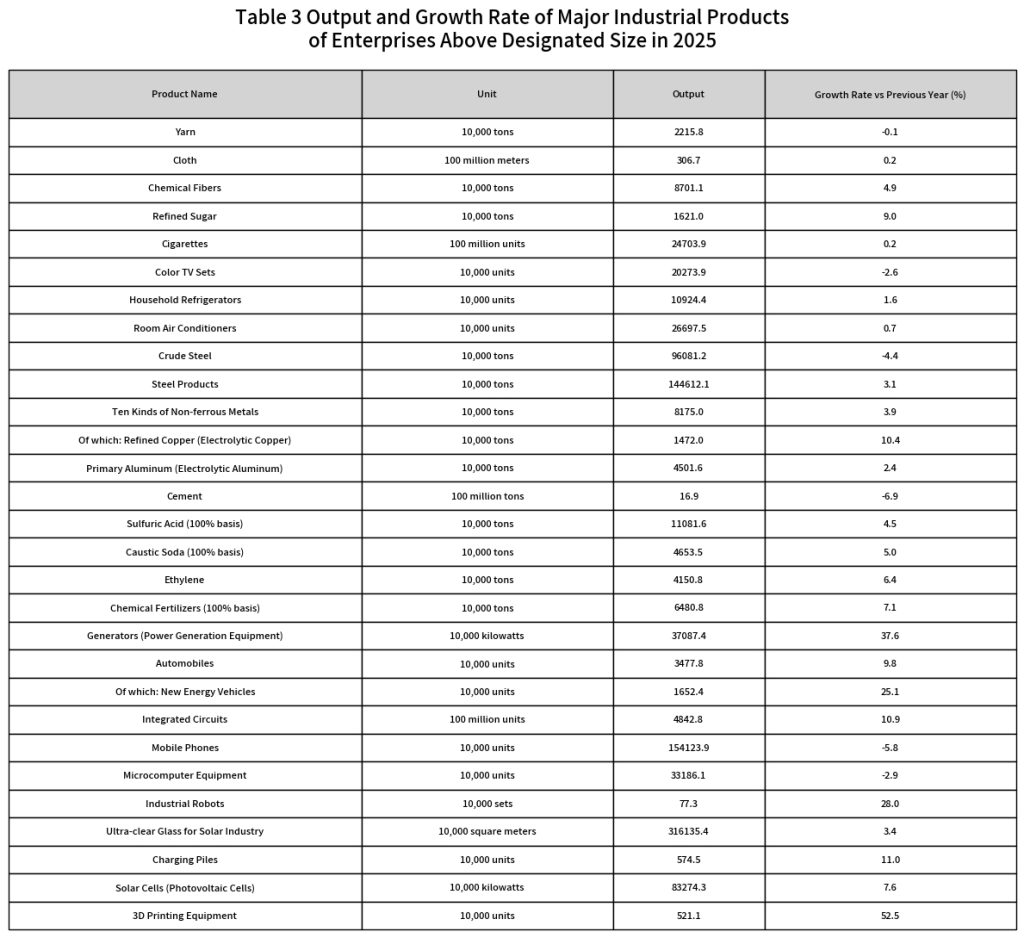
New‑quality productive forces grew steadily. For the full year, among industrial enterprises above designated size, the value added of the equipment manufacturing industry increased by 9.2 percent year‑on‑year, accounting for 36.8 percent of the value added of industrial enterprises above designated size, and profits of equipment manufacturing enterprises grew by 7.7 percent. The value added of the high‑tech manufacturing industry increased by 9.4 percent, accounting for 17.1 percent of industrial value added, and profits of high‑tech manufacturing enterprises rose by 13.3 percent. Value‑added output in the digital product manufacturing sector grew by 9.3 percent, representing 12.5 percent of the value‑added output of large‑scale industrial enterprises. The output of service robots reached 18.581 million units, up by 16.1 percent year‑on‑year; the output of mobile communication base station equipment reached 5.364 million RF modules, an increase of 13.5 percent; and server output reached 5.97 million units, an increase of 12.6 percent. Among enterprises above designated size in certain service sectors, operating revenue for strategic emerging service industries increased by 9.3 percent year‑on‑year, while operating revenue for high‑tech service industries rose by 7.9 percent. E‑commerce transaction volume reached 46.7339 trillion yuan, an increase of 2.5 percent year‑on‑year, and online retail sales reached 15.9722 trillion yuan, an increase of 8.6 percent. In fixed‑asset investment (excluding rural households), investment in the purchase of equipment and tools increased by 11.8 percent year‑on‑year. A total of 25.74 million new business entities were established throughout the year, averaging 26,000 new enterprises per day.
Steady progress was made in promoting urban‑rural integration and coordinated regional development. By the end of the year, the urbanization rate of the permanent resident population stood at 67.89 percent, an increase of 0.89 percentage points from the end of the previous year. By region, the eastern region’s GDP for the year was 7,308.76 billion yuan, up by 5.0 percent from the previous year; the central region’s GDP was 2,991.08 billion yuan, up by 5.2 percent; the western region’s GDP was 2,987.50 billion yuan, up by 5.1 percent; and the northeastern region’s GDP was 650.35 billion yuan, up by 4.1 percent. For the full year, the GDP of the Beijing‑Tianjin‑Hebei region was 11.9918 trillion yuan, up by 5.4 percent; the GDP of the Yangtze River Economic Belt was 65.8336 trillion yuan, up by 5.2 percent; and the GDP of the Yangtze River Delta region was 34.6595 trillion yuan, up by 5.4 percent. New progress was also made in the implementation of major regional strategies such as the development of the Guangdong‑Hong Kong‑Macao Greater Bay Area and the ecological protection and high‑quality development of the Yellow River Basin. Moreover, the Hainan Free Trade Port launched island‑wide customs clearance operations.
Finally, total industrial value‑added for the year reached 41.6826 trillion yuan, up by 5.8 percent from the previous year. Value‑added from large‑scale industrial enterprises grew by 5.9 percent. Within large‑scale industrial enterprises, classified by economic type, value‑added from state‑controlled enterprises increased by 4.6 percent; from joint‑stock enterprises by 6.3 percent; from foreign‑invested and Hong Kong, Macao, and Taiwan‑invested enterprises by 3.9 percent; and from private enterprises by 5.3 percent. By sector, mining grew by 5.6 percent, manufacturing by 6.4 percent, and the production and supply of electricity, heat, gas, and water by 2.3 percent.
In the industrial sector above designated size for the year, value-added in the processing of agricultural and sideline products increased by 5.6% year-on-year, the textile industry grew by 3.0%, the chemical raw materials and chemical products manufacturing industry grew by 7.8%, the non-metallic mineral products industry declined by 0.6%, the ferrous metal smelting and rolling industry grew by 4.5%, the general machinery manufacturing industry grew by 8.0%, the special-purpose machinery manufacturing industry grew by 4.3%, the automobile manufacturing industry grew by 11.5%, the electrical machinery and equipment manufacturing industry grew by 9.2%, the computer, communications, and other electronic equipment manufacturing sector grew by 10.6%, and the electricity, heat production, and supply sector grew by 2.2%.
For the full year, profits of industrial enterprises above designated size totaled 7,398.2 billion yuan, an increase of 0.6% over the previous year. By economic type, profits of state-controlled enterprises amounted to 2,056.1 billion yuan, a decrease of 3.9% from the previous year; joint-stock enterprises recorded 5,540.8 billion yuan, down 0.1%; foreign-invested and Hong Kong, Macao, and Taiwan-invested enterprises recorded 1,744.7 billion yuan, up 4.2%; and private enterprises recorded 2,281.1 billion yuan, unchanged from the previous year. By sector, profits in the mining industry were 834.5 billion yuan, down 26.2% from the previous year; in the manufacturing industry, 5,691.6 billion yuan, up 5.0%; the electricity, heat, gas, and water production and supply sector recorded 872.1 billion yuan, an increase of 9.4%. The cost per 100 yuan of operating revenue for industrial enterprises above designated size was 85.31 yuan, an increase of 0.16 yuan from the previous year; the operating profit margin was 5.31%, a decrease of 0.03 percentage points. At the end of the year, the asset-liability ratio of industrial enterprises above designated size was 57.6%, a decrease of 0.1 percentage points from the end of the previous year. The capacity utilization rate of industrial enterprises above designated size for the full year was 74.4%.
According to preliminary calculations, total primary energy production for the year was 5.13 billion tons of standard coal, an increase of 3.6% from the previous year.
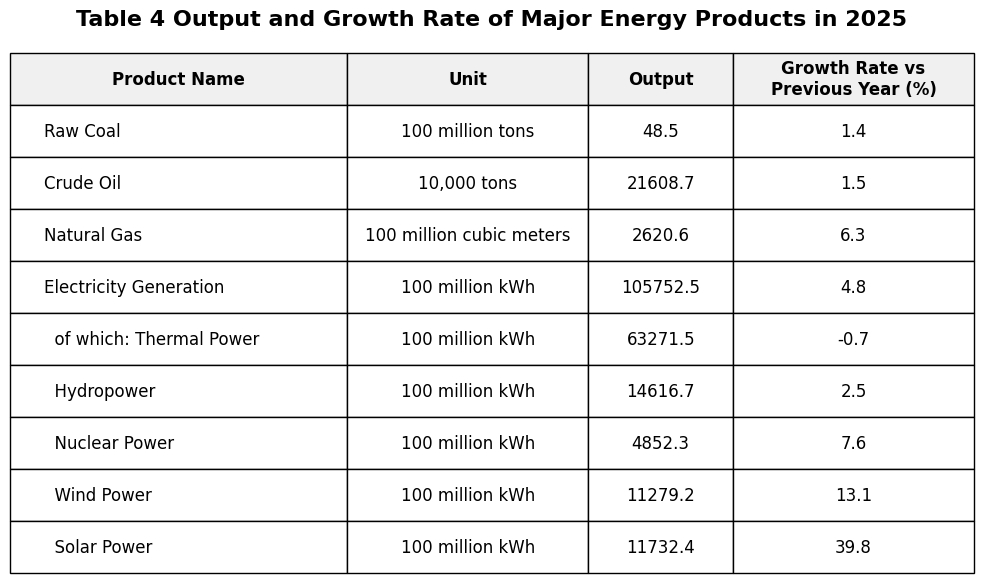
At the end of the year, the national installed power generation capacity was 389,134 megawatts, an increase of 16.1% from the end of the previous year . Of this total, thermal power installed capacity was 153,904 MW, an increase of 6.3%; hydropower installed capacity was 44,802 MW, an increase of 2.9%; nuclear power installed capacity was 6,248 MW, an increase of 2.7%; wind power installed capacity was 64,001 MW, an increase of 22.9%; solar power installed capacity reached 120,173 MW, an increase of 35.4%.
The value added of the construction industry for the year was 8.6425 trillion yuan, a decrease of 1.1% from the previous year. Profits of qualified general contracting and specialized contracting construction enterprises nationwide totaled 635.5 billion yuan, a decrease of 14.1% from the previous year, of which profits of state-controlled enterprises amounted to 347.3 billion yuan, a decrease of 8.2%.